Camino de Guadalupe
Before you goMass and prayerBefore the imageMapRouteAfterwardPractical informationLeer en español
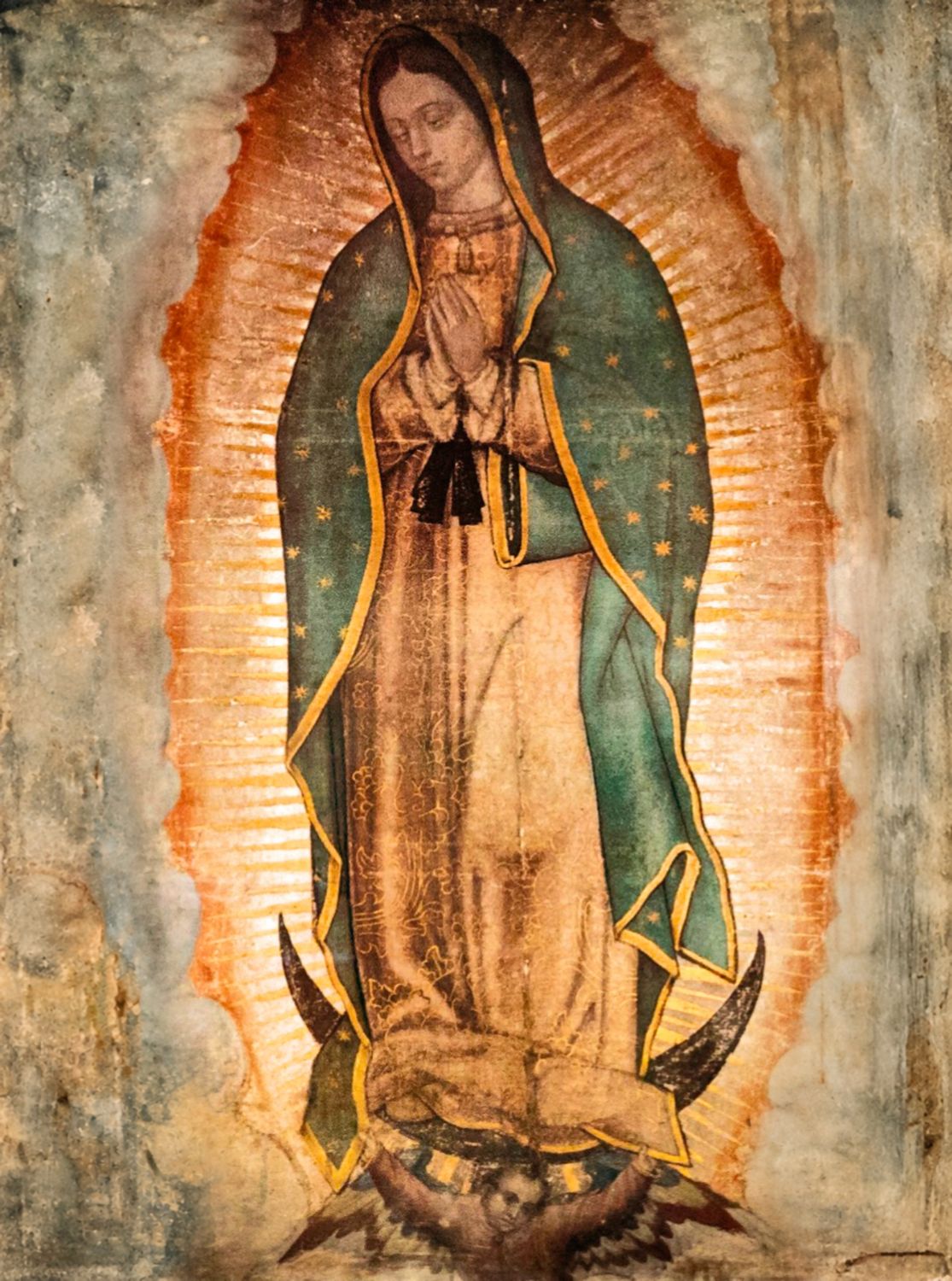
Image of the Virgin of Guadalupe

Guadalupe Pilgrim’s Guide

Come to Guadalupe
with your whole heart

A simple route to arrive prepared, recognize each place, stop to pray and return home with a mission.

At the heart of the pilgrimage

Two moments to live fervently

To live the Mass

Mary asked for her “sacred little house” to be built so that she could show us and give us her Son, Jesus Christ. That is why the celebration of the Eucharist is the heart of the pilgrimage: Mary leads us to the encounter with Jesus, alive and present among us.

Take part in Mass attentively and recollectedly. Listen to the Word as a personal call, place on the altar the intentions you carry with you, and receive Jesus with gratitude.

“Mother of Guadalupe, you who wished to give us your Son, help me to meet him in this Eucharist. Teach me to listen to his Word, to offer him my life and to receive him with faith and love.”

To contemplate the image

Stop before the Virgin without hurrying. Before looking at the symbols in the image, remember that you are before a Mother who wanted to come close to her children to listen to them, console them and show them her love.

Look at her knowing that she also says to you: “Am I not here, I who am your mother?” Tell her what you carry in your heart: your joys, worries, wounds, thanks and hopes. Then keep silent and let her look at you.

“My Mother of Guadalupe, here I am. Listen to me, console me and shelter me in the hollow of your mantle. Lead me to your Son Jesus Christ and teach me to do whatever he asks of me.”

Before the image

Five minutes to be truly present

Do not try to say everything. Leave room to look, listen and offer.

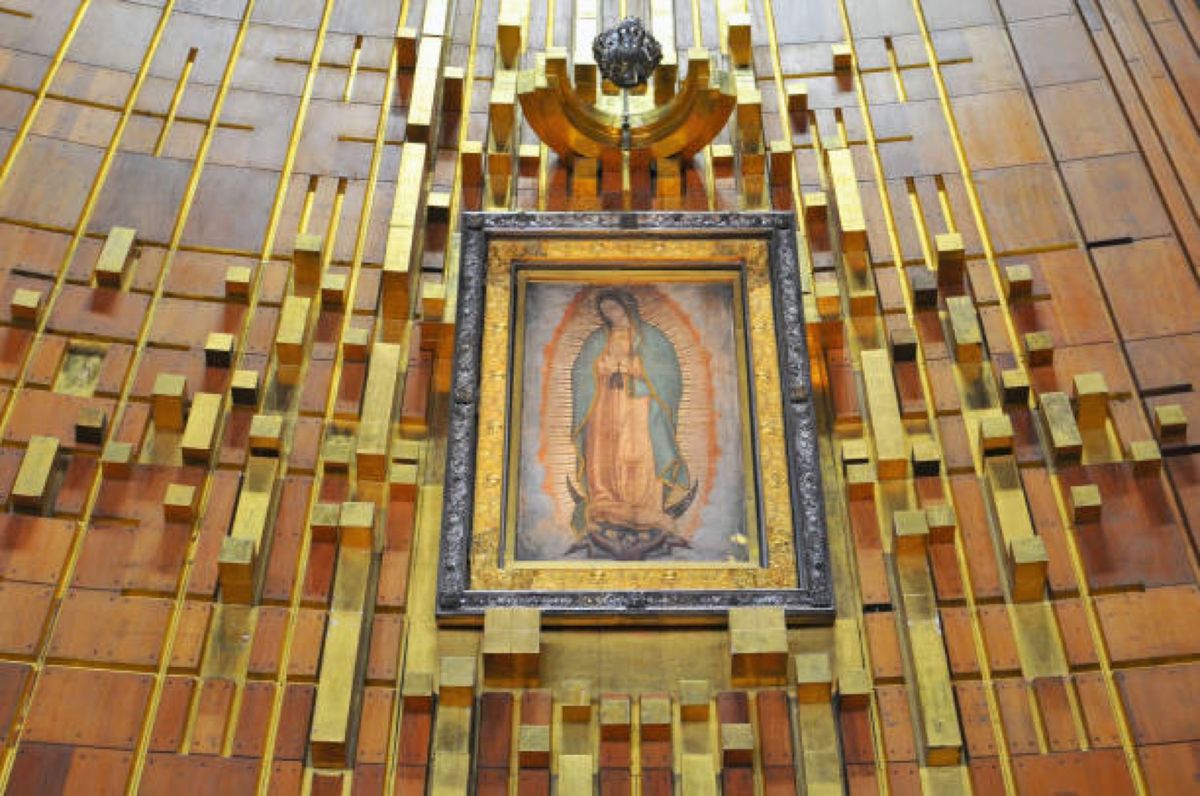
Image of the Virgin of Guadalupe in the New Basilica
  1. 1
    Arrive

    Breathe and keep silent. Remember that you are welcomed as a son or daughter.

  2. 2
    Look

    Contemplate the face, the hands, the sash over her womb, the mantle and the rays of light.

  3. 3
    Listen

    Repeat slowly: “Am I not here, I who am your mother?”

  4. 4
    Offer

    Name the people, wounds, thanks and decisions you bring with you.

  5. 5
    Respond

    Ask: “Mother, what do you hope for from me today? What can I do for you?”

Marian consecration

Place yourself in her hands to belong more fully to Jesus Christ

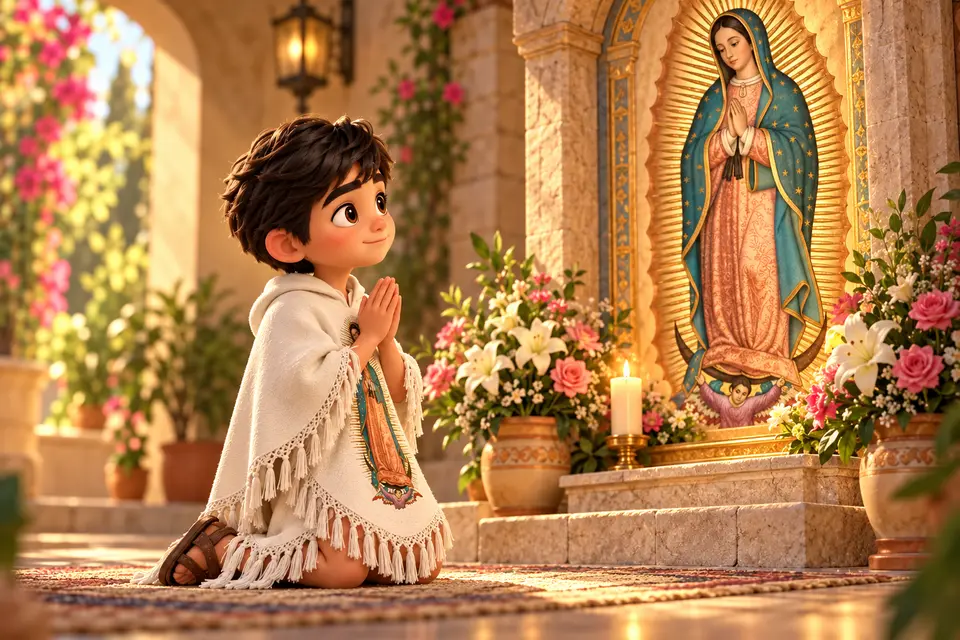
Juanito kneeling before the Virgin of Guadalupe, making his consecration

I am at the Villa · A time of grace

Guadalupan Jubilee Year

October 12, 2026 – October 12, 2027

Pope Leo XIV granted this Jubilee Year for the 50th anniversary of the dedication of the New Basilica of Holy Mary of Guadalupe and of the transfer of the Sacred Image, which took place on October 12, 1976. It is an invitation to spiritual renewal, conversion and encounter with Jesus Christ under the gaze of Holy Mary of Guadalupe.

How can I receive the plenary indulgence?

  1. Visit the Basilica of Guadalupe, the Sacred Little House, with devotion and a contrite spirit.
  2. Take part in a liturgical celebration or spend some time in prayer inside the Basilica.
  3. Fulfill the usual conditions: sacramental confession, Eucharistic communion, praying the Creed and prayer for the intentions of the Holy Father.

The indulgence can be received for oneself or applied to the souls in Purgatory.

Get your bearings before you walk

Route map

A real view of the whole Villa and the nine stops in the recommended order.

The map needs a connection. The numbered list and the route texts remain available in the installed guide. Check on site for possible closures or changes of access.

Essential route · 9 stops

Walk through the history of the Sacred Little House

The order is a suggestion for an unhurried visit. You can adapt it to the Mass times, the flow of pilgrims and your own strength.

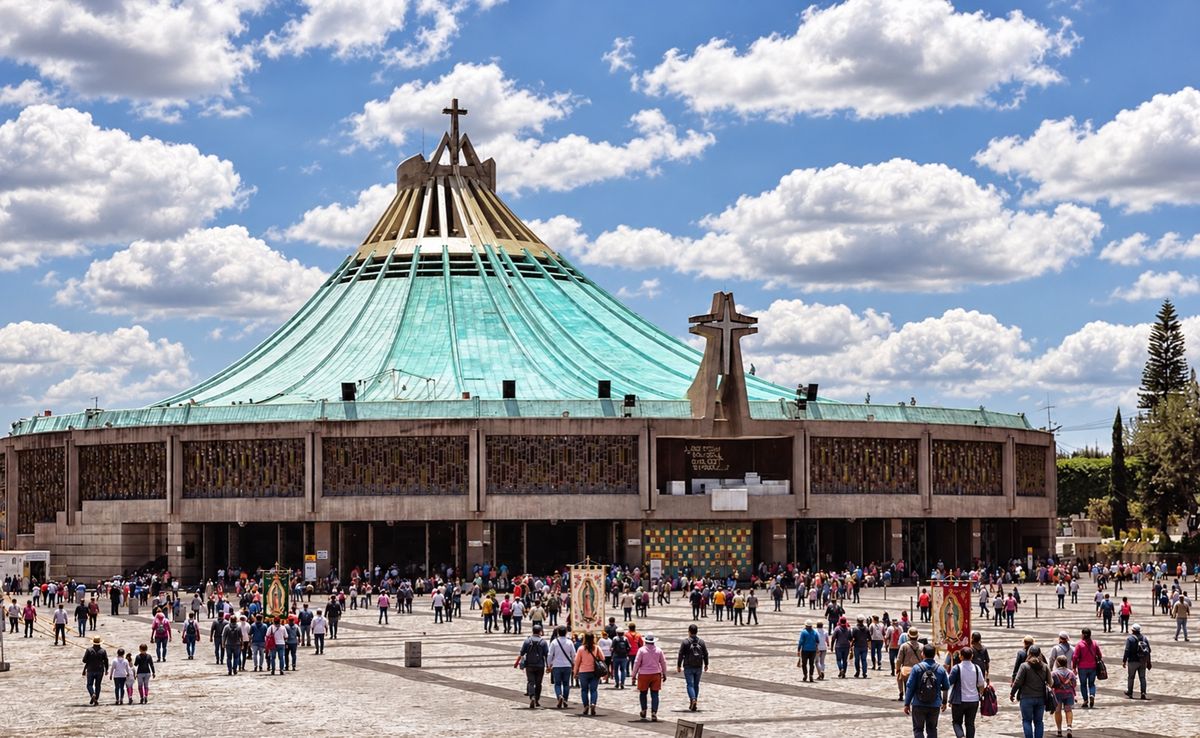
Exterior of the New Basilica of Guadalupe
01Heart of the visit · 25–40 min

New Basilica

Construction began in 1974, and it was inaugurated on October 12, 1976, the day the image of the Virgin of Guadalupe was moved here. Its circular floor plan, with no central columns, allows the original tilma of Saint Juan Diego to be seen from any point.

“Because truly I am honored to be your compassionate mother, yours and that of all the people who live together in this land… Because there I will truly listen to their weeping, their sadness, to remedy and heal all their different sorrows, their miseries, their pains.”

Mary’s words to Juan Diego · Nican Mopohua, 29–32
Read the full history

The present Basilica of Guadalupe, in the north of Mexico City, is considered the second most visited Catholic shrine in the world. Its circular structure and copper roof were conceived to evoke the Virgin’s mantle sheltering the pilgrims. Since it has no central supporting columns, the altar can be seen from anywhere inside.

It was designed by Pedro Ramírez Vázquez and his team, together with the architects José Luis Benlliure, Alejandro Schoenhofer, Fray Gabriel Chávez de la Mora and Javier García Lascuráin.

At the center, behind the altar, the original tilma of Saint Juan Diego is displayed. A system of moving walkways allows visitors to see it up close without interrupting the flow of people. In front of the church, the Atrium of the Americas was designed to hold up to 50,000 people and to receive the great pilgrimages that arrive year after year.

Look

The copper roof, like a sheltering mantle; the image behind the altar and the moving walkways that let you see it up close.

Pray

“Mother, here I am. Show me your Son and receive those I carry in my heart.”

Understand the symbols of the image ↗
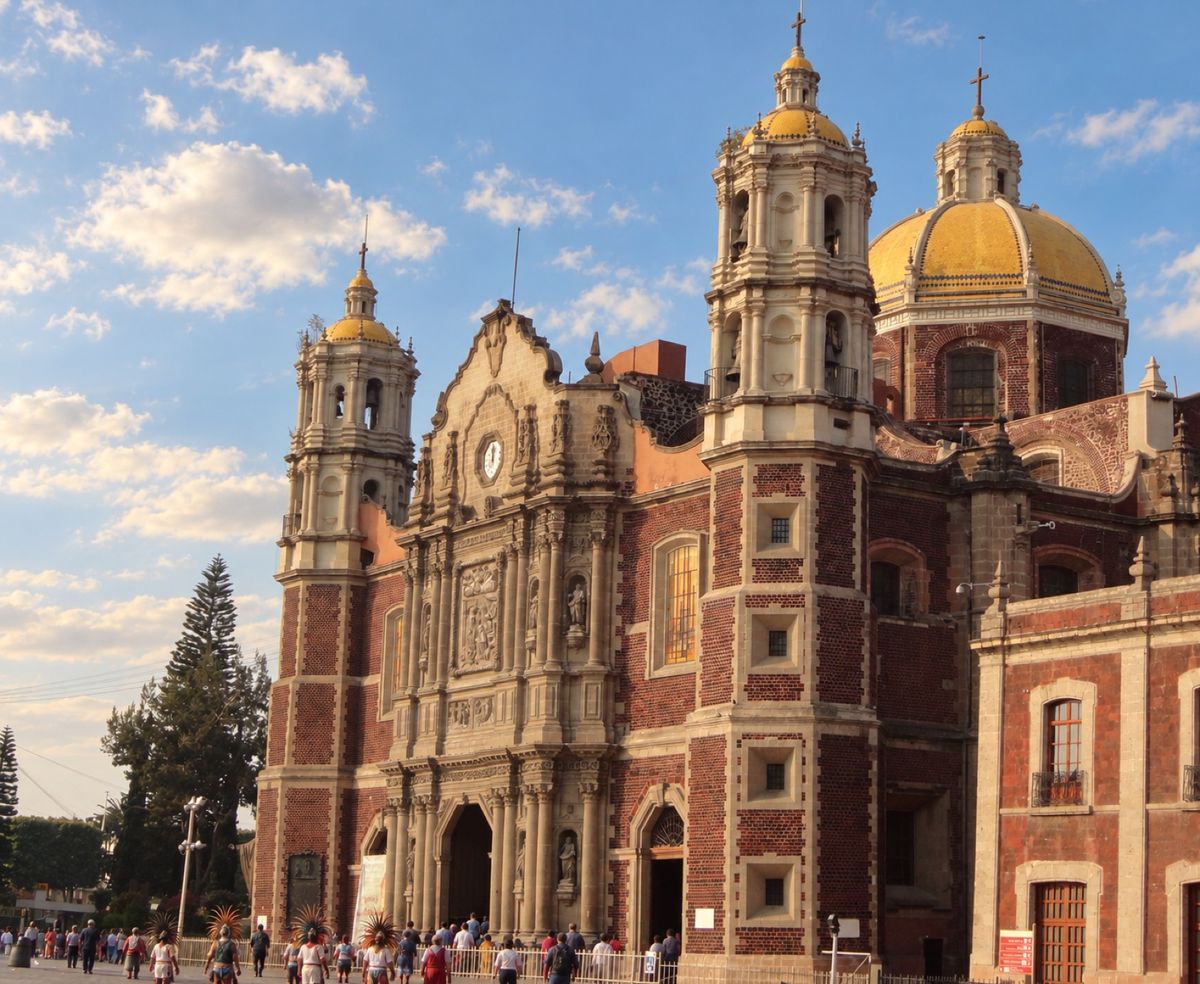
Façade of the Expiatory Temple of Christ the King, the Old Basilica
02Eucharistic silence · 15–25 min

Old Basilica

This Baroque church, beside the New Basilica, was begun in 1695 and opened its doors in 1709. It was the main shrine of Guadalupe for 267 years. Today it is the Expiatory Temple of Christ the King and a place of perpetual adoration of Jesus in the Eucharist.

“Where I will show him, I will exalt him by making him manifest, I will give him to people in all my personal love, him who is my compassionate gaze, him who is my help, him who is my salvation.”

Mary’s words to Juan Diego · Nican Mopohua, 27–28
Read the full history

When the New Basilica was inaugurated in 1976, it closed temporarily because of the structural damage caused by the former lakebed soil; it was later rescued and reopened as an Expiatory Temple.

It is the work of the architect Pedro de Arrieta. Notable features include its Baroque façade, its four octagonal towers, the dome covered with Talavera tiles and the high altar designed by Manuel Tolsá.

Look

The tilt that recalls the former lakebed soil and the patient work of structural rescue.

Pray

In Eucharistic adoration, let your Marian devotion lead you to the center: Jesus Christ.

The apparitions at a glance ↗
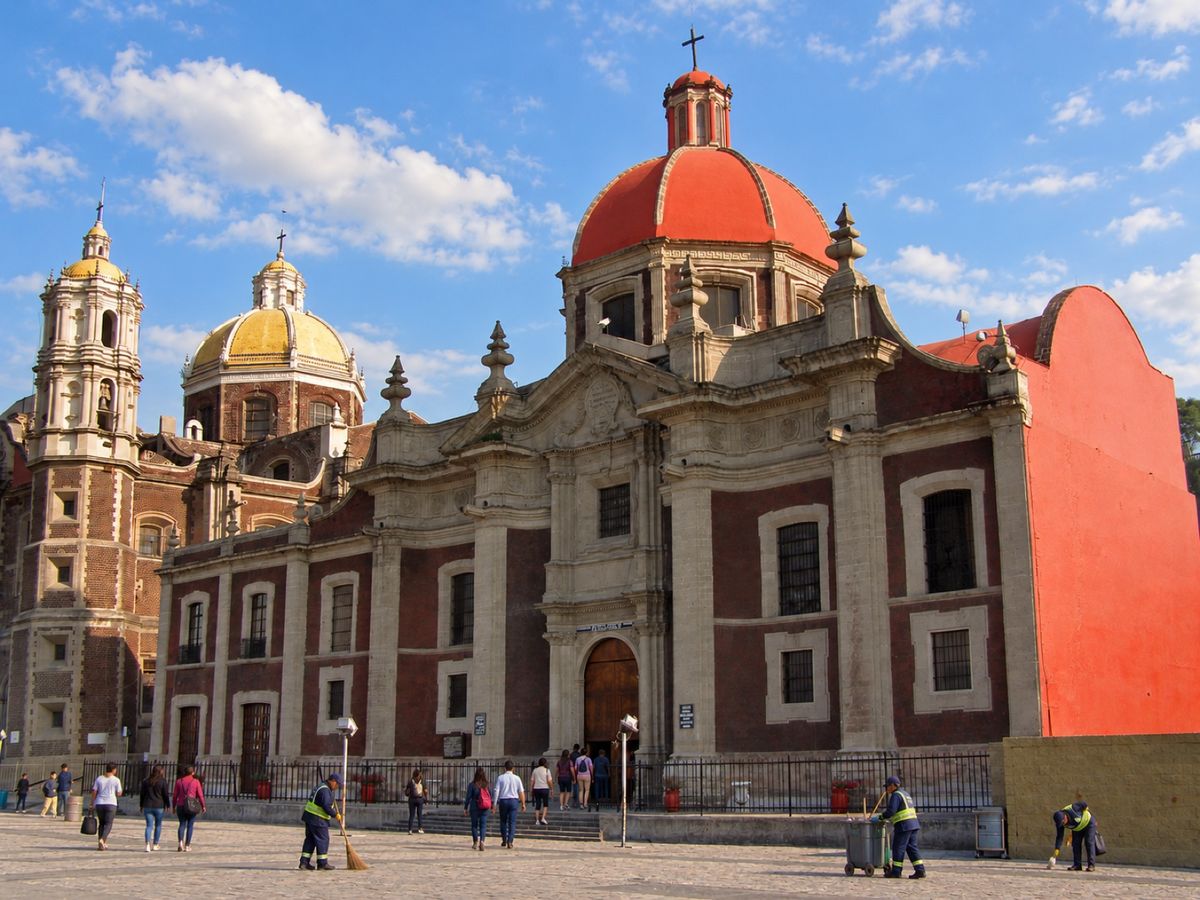
Expiatory Temple and Capuchin Parish at the Villa of Guadalupe
03Memory and consecrated life · 10–15 min

Capuchin Convent (Capuchinas)

This beautiful building, beside the Old Basilica, was designed by the architect Ignacio Castera and built in the last decade of the eighteenth century, in the time of Archbishop Alonso Núñez de Haro y Peralta. The Sacred Image was kept here on two occasions. After a major reconstruction, the church reopened in 1996.

“And know, my little son, that I will repay your care and the work and weariness you have spent for me.”

Mary’s words to Juan Diego · Nican Mopohua, 92
Read the full history

The Sacred Image was kept here first from July 10 to December 10, 1791, and again from February 23 to October 2, 1888. Because of the kind of subsoil it stands on, like the Old Basilica, the building came to lean dangerously and had to be closed from 1970 to 1996 for a major reconstruction.

Inside, the central altarpiece stands out majestically, with the image of the Guadalupan Holy Family: a circular acrylic painting on canvas, four meters in diameter, made in 1998 by Fray Gabriel Chávez de la Mora and the architect Jaime Domínguez Montes, at the request of Canon Dr. F. Armando Colín.

Look

The central altarpiece and the circular image of the Guadalupan Holy Family, created in 1998.

Pray

Give thanks for those who have sustained the faith with a hidden life of prayer and service.

Mary’s way of teaching ↗
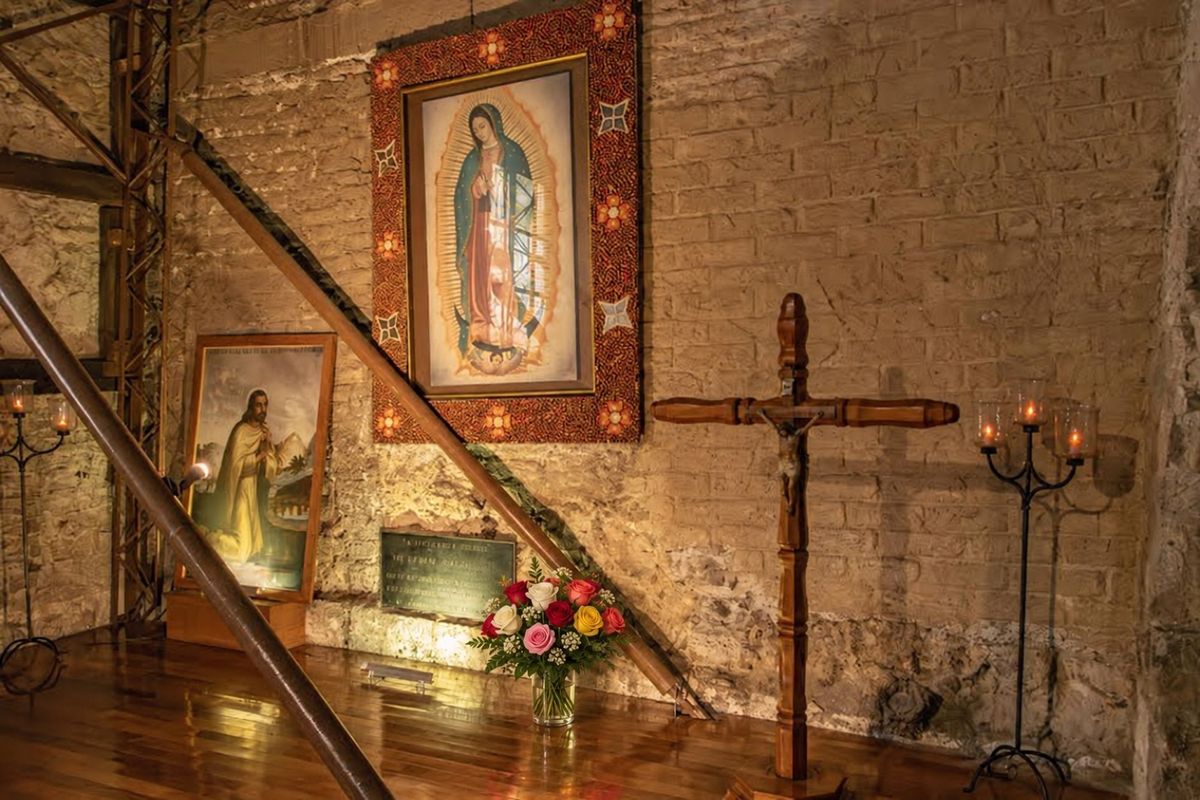
Interior of the Old Parish of the Indians
04The origin of the Little House · 15–25 min

Old Parish of the Indians (Antigua Parroquia de Indios)

It is the oldest surviving building in the complex, built around 1649. Inside are the ruins of the first Sacred Little House, the hermitage built to fulfill the wish the Virgin expressed to Saint Juan Diego in 1531.

“I want very much, I greatly desire, that they build my sacred little house here.”

Mary’s words to Juan Diego · Nican Mopohua, 26
Read the full history

It was built at the request of Luis Lasso de la Vega, vicar of what was then the Villa of Guadalupe and responsible for printing the Nican Mopohua, the Nahuatl account of the apparitions attributed to Antonio Valeriano. It also preserves remains of the church promoted by Archbishop Montúfar in 1556 and of a third church from 1622, known as “the church with the coffered ceiling” for its richly decorated wooden roof; no part of this last church is still standing.

Tradition places next to this site the house where Saint Juan Diego lived until his death in 1548, devoted to caring for the Sacred Image. An Indigenous confraternity was established here in 1679. The church housed the ayate (tilma) from 1695 to 1709 and the banner associated with Miguel Hidalgo from 1853 to 1896.

For some years in the twentieth century it stood without a roof, exposed to the weather. Thanks to the work of a group of priests, it was restored in 1998, the 450th anniversary of the death of Saint Juan Diego.

Look

The remains of the earlier churches and, next to the building, the site where tradition places Juan Diego’s house.

Pray

“Mary, make me a messenger. Teach me to serve with simplicity and faithfulness.”

The little house as a synthesis ↗
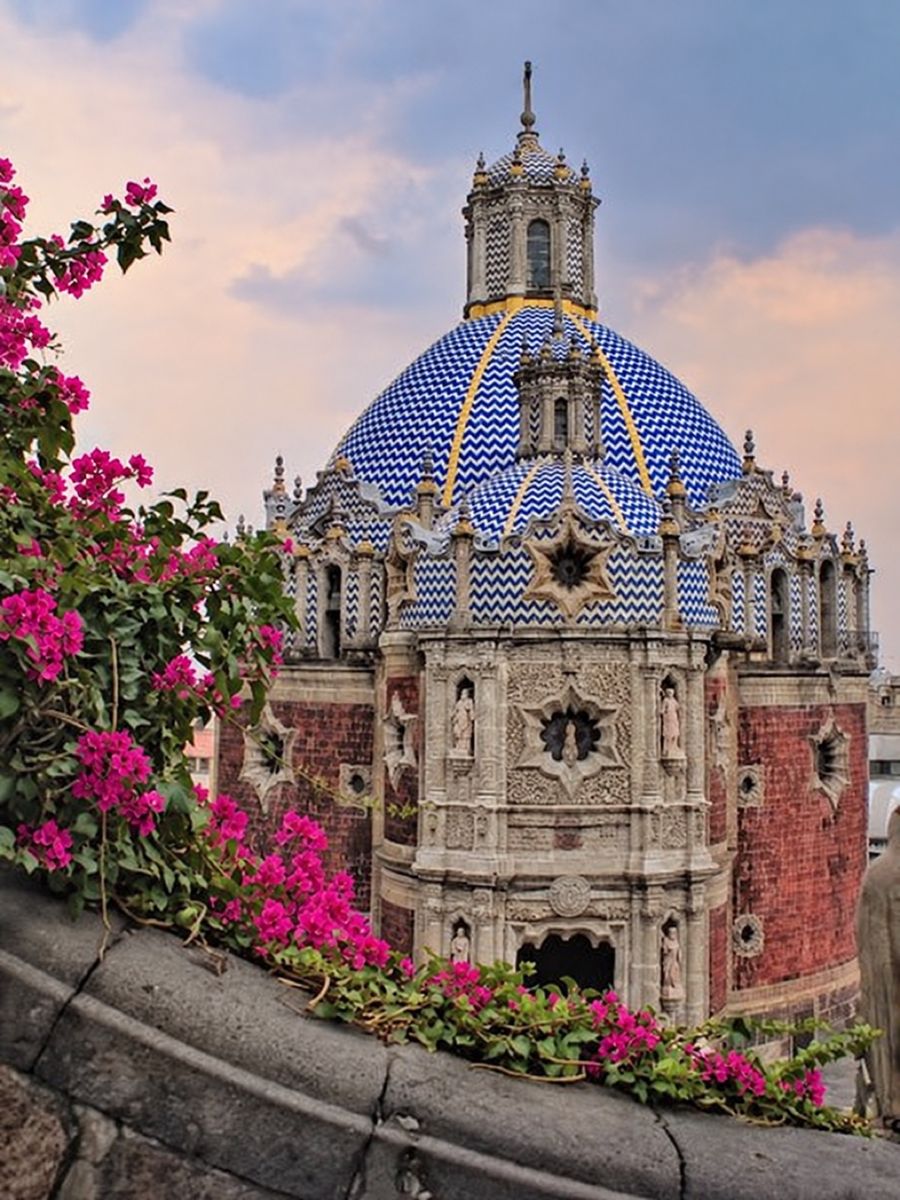
Baroque exterior of the Chapel of the Little Well
05Water and Baroque beauty · 15–25 min

Chapel of the Little Well (Capilla del Pocito)

Built between 1777 and 1791 by Francisco Guerrero y Torres over a well of drinking water, it is one of the jewels of Mexican Baroque.

According to tradition, it was near here that Mary came out to meet Juan Diego on December 12 and said to him:

“Am I not here, I who am your mother? Are you not under my shadow and protection? Am I not the source of your joy? Are you not in the hollow of my mantle, in the crossing of my arms?”

Nican Mopohua, 119
Read the full history

Tradition links this site with the spring that gushed forth when Juan Diego showed the bishop the place of the apparitions. Luis Lasso de la Vega covered the spring around 1648; when the earlier structure deteriorated, the present church was begun in 1777 and completed in 1791.

During the colonial period, thousands of sick people came to drink the water and wash their wounds with it. On December 22, 1815, José María Morelos y Pavón obtained permission to pray here before being executed in Ecatepec.

Its octagonal floor plan, its three domes, its tile decoration and its windows of varied shapes create a sense of movement. The chapel brings together architecture, Marian devotion and the memory of water as a sign of life and grace.

Look

The unusual floor plan, the movement of the domes and the Marian symbols in the decoration.

Pray

Give thanks for your Baptism and ask for a pure heart, able to receive grace and pass it on.

The message of the Virgin of Guadalupe ↗
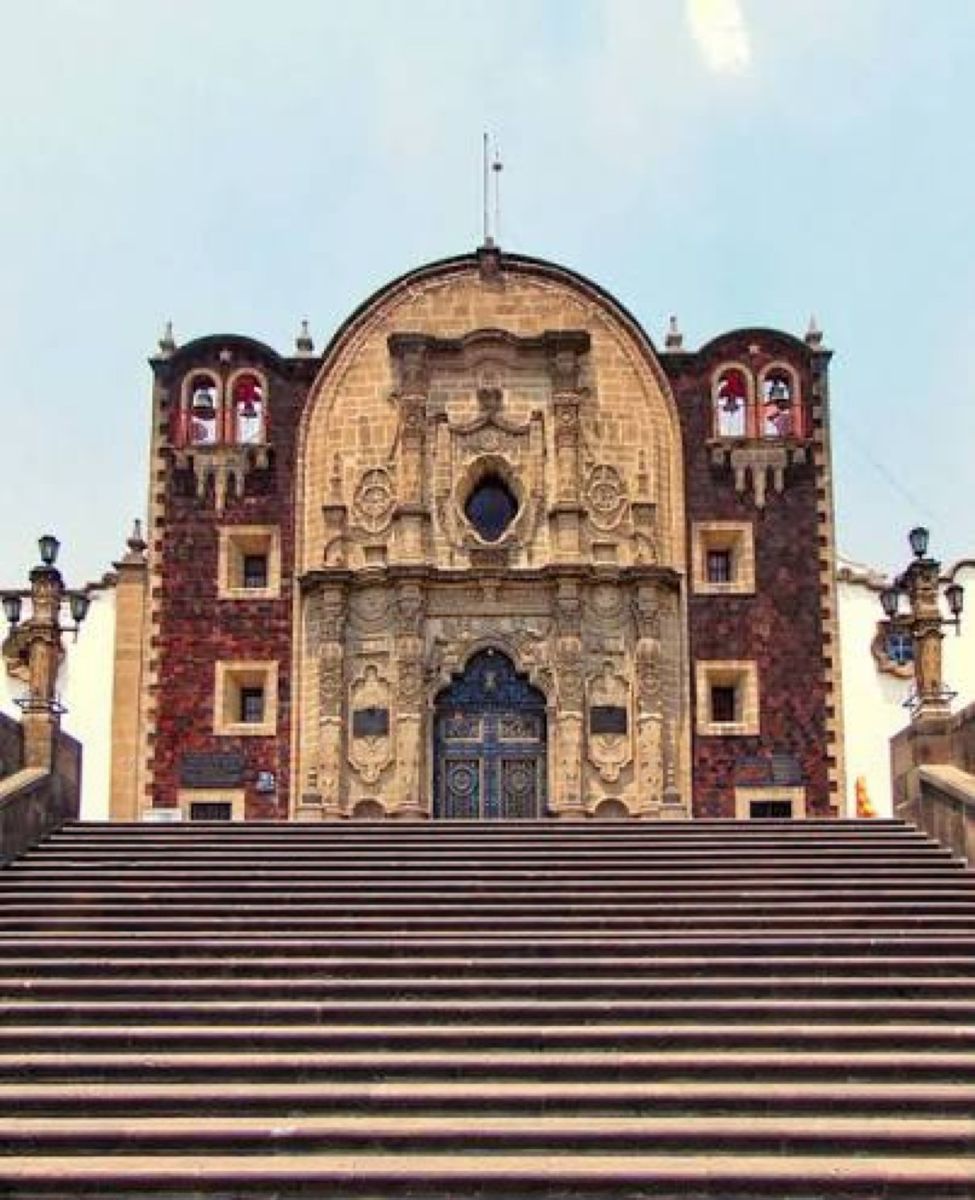
Façade of the Chapel of the Little Hill at the top of the stairway
06The miracle of the roses · 20–30 min

Chapel of the Little Hill, or of the Roses (Capilla del Cerrito)

Here, at the top of Tepeyac, tradition places the first apparition of the Virgin of Guadalupe to Saint Juan Diego Cuauhtlatoatzin, on December 9, 1531. It also commemorates the place where, days later, Juan Diego cut fresh roses in the middle of winter at the Virgin’s instruction.

“Go up, you, the youngest and dearest of my sons, to the summit of the little hill, there where you saw me and where I gave you my command; there you will see various flowers spread out: cut them, gather them, put them all together.”

Mary’s words to Juan Diego · Nican Mopohua, 125–126
Read the full history

The first hermitage was built in 1666. Construction of the present building began in 1740 by order of the priest Juan José de Montúfar, and it was rebuilt between 1945 and 1950.

Inside are the frescoes painted by Fernando Leal in 1947, which tell the story of the Guadalupan apparitions. In the plaza outside stand the sculptures of the archangels Michael, Raphael, Gabriel and Uriel, along with four marble angels.

From the terrace you can see the whole Villa and the valley. Behind the chapel is the Tepeyac Cemetery.

Look

The frescoes by Fernando Leal, the sculptures of the archangels and the view of the shrine from the top.

Pray

“Mother, teach me to discover the roses that God makes bloom even in difficult times.”

Read the Nican Mopohua ↗
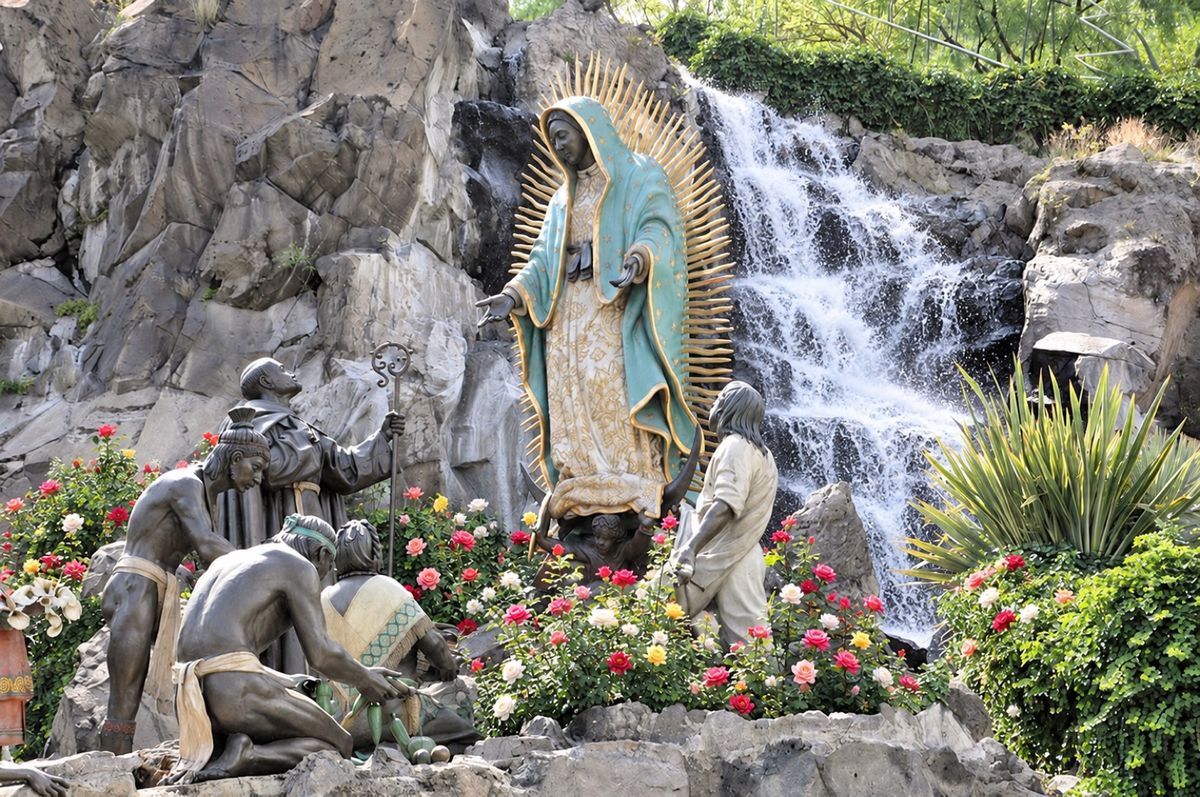
The Offering sculpture group in the Tepeyac Gardens
07The people offer their lives · 15–25 min

The Offering (La Ofrenda)

This imposing sculpture group stands in the Tepeyac Garden, also called the Sacred Garden or Offering Park, on the eastern slope of the hill. It represents the apparitions of the Virgin of Guadalupe and the encounter between the Indigenous world and the Catholic faith.

“Listen, you, the youngest and dearest of my sons, be sure that I do not lack servants and messengers… but it is necessary that you, personally, go and plead, that through your intercession my desire, my will, may be fulfilled and carried out.”

Mary’s words to Juan Diego · Nican Mopohua, 58–59
Read the full history

The work was commissioned by the Tepeyac Trust in 1982 and officially inaugurated in September 1986. It was designed by the artist and architect Aurelio G. D. Mendoza; the bronze sculptures were made in collaboration with Alberto Pérez Soria and Gerardo Quiroz.

The group includes seventeen sculptures: the Virgin, Saint Juan Diego, Fray Juan de Zumárraga and various figures presenting flowers, maize, incense and other gifts. The figures, the fountain and the waterfalls turn the garden into a living scene of encounter, gratitude and self-giving.

The site is managed and cared for by the Cerro del Tepeyac Trust, a body devoted to the conservation, maintenance and cultural and religious promotion of this historic heritage area.

Look

The faces, the gifts being offered and the way everyone turns their gaze toward Mary.

Ask yourself

What do I bring to offer today: thanks, a wound, a decision or an act of service?

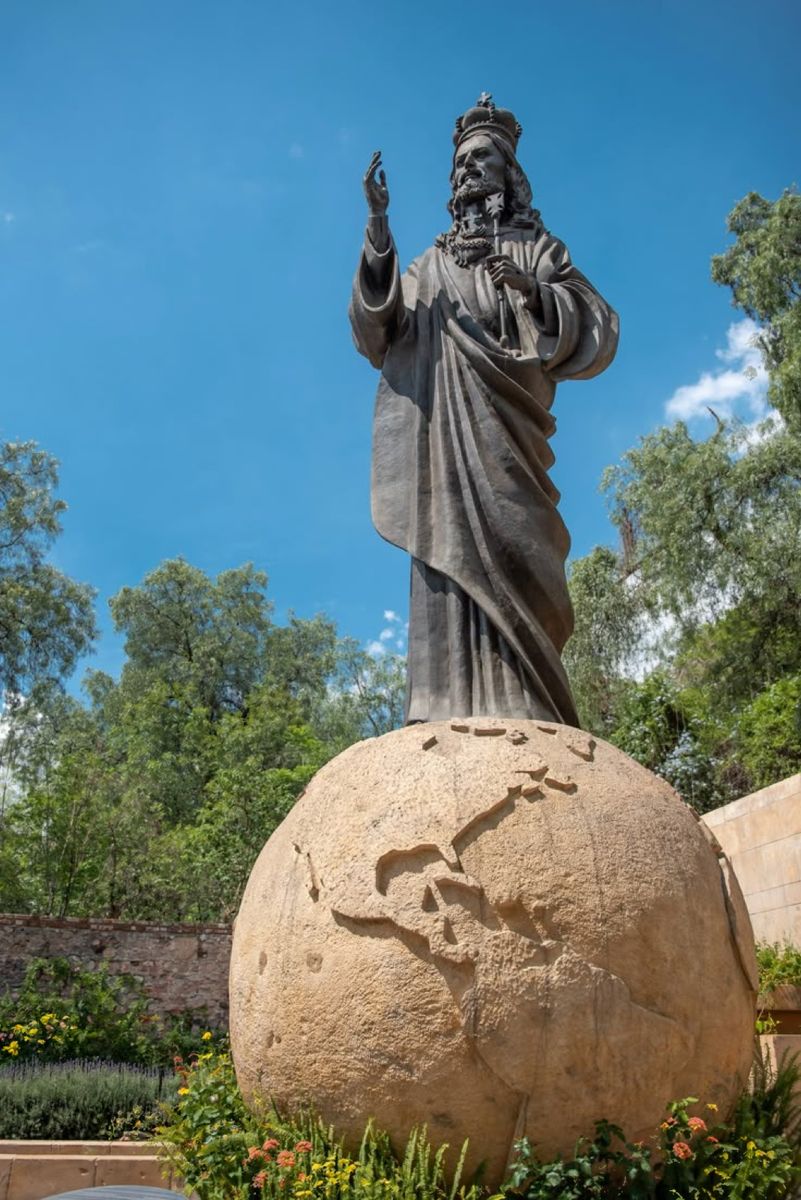
Monument to Christ the King on Tepeyac Hill
08Christ, the center of the pilgrimage · 20–30 min

Monument to Christ the King

On the slopes of Tepeyac, the Way of the Beatitudes leads to the monument to Christ the King, an invitation to remember that Mary always leads us to Jesus Christ.

“I am the ever-perfect Virgin Holy Mary, Mother of the very true God, by whom we live, the Creator of persons, the Lord of what is near and close, the Lord of heaven, the Lord of the earth.”

Mary’s words to Juan Diego · Nican Mopohua, 26
Read the full history

The monument was erected on Tepeyac Hill on November 23, 2013, to honor and acknowledge the kingship of Jesus Christ. Its crowning was part of the closing of the Year of Faith and of the commemoration of the centenary of Mexico’s consecration to the Sacred Heart of Christ the King, made in 1914.

The path that leads up to it is inspired by the Beatitudes. The sculpture shows Christ with open arms and his Sacred Heart revealed: an image of welcome, mercy and self-giving.

Look

Christ’s open arms, the Sacred Heart and the view that joins the hill and the Basilica once again.

Pray

“Jesus, King and center of my life, receive my pilgrimage. Make my heart like yours.”

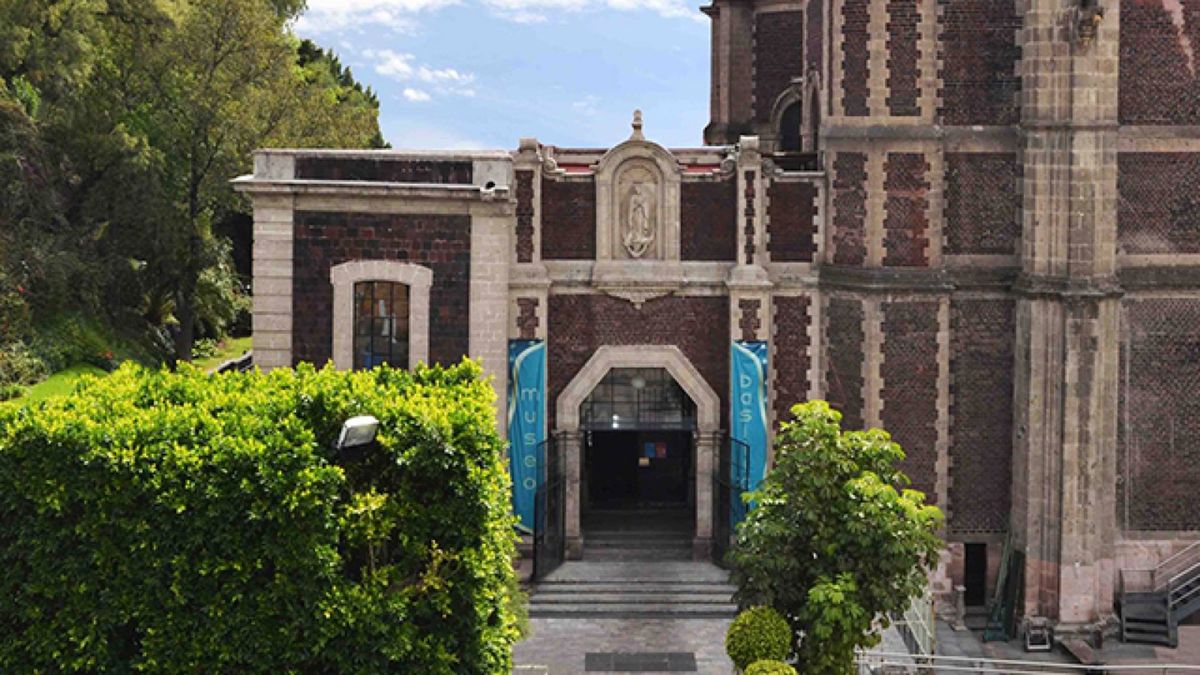
Entrance to the Basilica Museum
09Art and culture · 30–60 min

Basilica Museum

Here you discover how each generation has received and expressed the Guadalupan Event: early copies of the image, paintings, ex-votos and devotional objects left by four centuries of pilgrims.

“You will tell him everything you have seen and marveled at, and what you have heard.”

Mary’s words to Juan Diego · Nican Mopohua, 33
Read the full history

It preserves, studies and shares nearly 4,000 cultural assets held by the Insigne y Nacional Basílica de Guadalupe. Its Guadalupan art collection includes painting, sculpture, mixed media, engraving, gold- and silverwork, applied arts, textiles, literature, architecture and ex-votos.

Among its testimonies are some of the earliest copies of the original image, made from the early seventeenth century onward, as well as medallions and painting cycles that tell the story of the apparitions. Permanently open to the public, the museum serves to pass on the Guadalupan message.

Look

The early Guadalupan copies and the medallions that tell the story of the apparitions.

Ask yourself

What have different generations discovered and expressed as they contemplated Guadalupe?

Official museum information (Spanish) ↗

During the visit

Did a question come up?

Juanito.ai can help you with specific questions about the Guadalupan Event, its protagonists, the image and its sources.

Ask Juanito.ai ↗
Juanito.ai, an assistant on the Guadalupan Event

After you return

Let the pilgrimage continue in your life

What you received becomes formation, reconciliation and service. Watch the 15 videos on the Guadalupan Event prepared by Camino de Guadalupe, on your own or in a group. The videos are in Spanish with English subtitles.

“And you, you who are my messenger, in you absolute trust is placed.”

Mary’s words to Juan Diego · Nican Mopohua, 139
A course in 15 videos on the Guadalupan Event
Go deeper

Complete course in 15 videos

History, Nican Mopohua, protagonists, symbols of the tilma and mission.

Start the course ↗

Four simple steps

  1. 1

    Give thanks. Write down one thing you received at the Villa.

  2. 2

    Share. Tell someone why that moment was important.

  3. 3

    Serve. Choose a concrete gesture of service, comfort, reconciliation or closeness.

  4. 4

    Decide and offer. Ask yourself whether from now on you can serve God and the Church as Juan Diego did.

Continue with “I Am Juan Diego” ↗

Practical information

Take the guide with you

Install on my phone

On iPhone or iPad

Open Safari’s Share menu and choose “Add to Home Screen.”

On Android

Open the browser menu and choose “Install app” or “Add to Home screen.”

The guide will be available as an app and will keep its main content so you can consult it even when your connection is limited.

Prayer

Consecration to the Virgin of Guadalupe

Holy Mary of Guadalupe,
Mother of the very true God, by whom we live,
today I come to you like Juan Diego,
poor, in need and trusting, to place myself in your hands.

Here I am, my Mother. I am your child. I am yours.

Receive my whole life: my past, with all it has been; my present, with all I am today; my future, with all that is to come.

You who call me by name and look on me with tenderness, welcome me as I am and teach me to live as a child of the Father and an apostle of Christ.

I give you my mind, so that it may think according to the Gospel; my heart, so that it may learn to love truly; my will, so that it may be ready to do good.

I give you my weaknesses and my fears, my weariness and my struggles. Place them under your motherly gaze and present them to your Son.

Teach me to do my part, with simplicity and faithfulness, and to trust that God will do the rest.

Mother, make me your messenger. Like Juan Diego, may I bring others what I have seen and heard, not with empty words but with a transformed life.

Place true roses in my hands: gestures of charity, words that console, a presence that accompanies. May my life be a sign that speaks of your Son.

Lead me to the sacred little house, to the encounter with Jesus Christ in the Eucharist, so that he may be the center of my life, the light that orders everything, the presence that sustains me.

Mother, I want to live under your mantle, walk in your way and learn to see as you see.

Today I consecrate myself to you so as to come more truly to your Son. Dispose of me as you will, send me wherever I am needed and make my life a place where God can dwell.

Holy Mary of Guadalupe, my Mother and my Lady, I am all yours. And all that I am and have I give to you, so that through you I may belong more fully to Jesus Christ.

Amen.

Prayer

Consecration to Christ the King

Jesus Christ, King of the universe, King of our lives and of our families, we come to you offering all that we are and have: our thoughts, our concerns, our qualities, our desires and our weaknesses.

We want to place them at your service, to work with you for the salvation of all people and the spread of your Kingdom in the world. Lovingly accept the consecration of our lives that we make to you today. Accept it as thanksgiving for all we have received from you.

Grant us the grace to follow the path of holiness by imitating your virtues and to bear public witness to our faith in you, so that all those with whom we live in society may find in us authentic disciples of yours, marked by universal charity, by harmony between their faith and their works, and by an ardent desire for your Kingdom to be established on earth.

Pour into our hearts the same sentiments that moved you to become man and die on the cross for the salvation of every person. Help us live faithfully the commandment of charity you left us as your testament. Set our hearts on fire, enlighten our minds, strengthen our decisions and lead us always along the path of faithfulness to your commandments.

Make us docile and passionate instruments of your love, so that we may serve our beloved Catholic Church more fruitfully, bringing your salvation and your message to many people.

Free us from all fear and selfishness, strengthen our faith and give us courage to respond to your call with generosity and faithfulness.

Amen.